Droply
Once upon a time, in a castle on a hill, there lived a kind prince. He wanted to find a true princess to be his friend and, one day, his bride. He traveled over mountains and across rivers, but every time he met someone, he wondered… is she really a princess?
So he came home to the castle, a little tired and a little sad.
One evening, a great storm rolled over the hill. The wind went whoooosh around the towers. The rain went pitter-patter, pitter-patter on the windows. Thunder rumbled far, far away.
Then… knock, knock, knock. Someone was at the castle gate.
The old king himself went to open it. There, in the rain, stood a young girl. Water dripped from her hair. Water ran into her shoes and out of her heels. But she smiled and said, "Good evening. I am a princess, and I am lost in the storm. May I come in?"
"A princess?" thought the queen. "We shall see." And she smiled a secret smile.
The queen went quietly up to the guest room. She took all the bedding off the bed. Then, right in the middle, she placed one tiny, round, green pea.
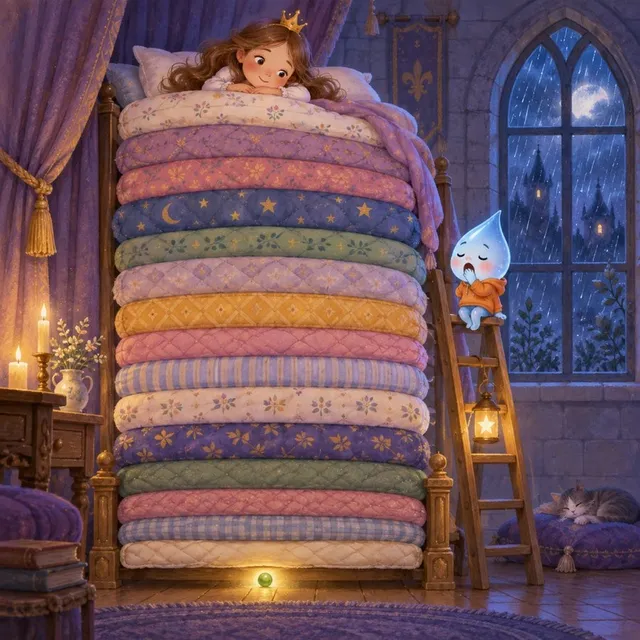
On top of the pea, she laid a mattress. Then another mattress. And another. Twenty soft mattresses, one on top of the other. Then, on top of those, she piled twenty fluffy feather quilts. The bed was so tall that the princess needed a ladder to climb in!
"Sleep well, my dear," said the queen.
The princess climbed up, up, up the ladder, snuggled under the top quilt, and closed her eyes.
In the morning, the sun peeked through the window. The princess came down to breakfast, rubbing her eyes.
"Did you sleep well?" asked the queen.
"Oh, not very well at all," said the princess politely. "There was something small and hard in my bed. I turned this way, and I turned that way, all night long. I think I am black and blue!"
The king, the queen, and the prince looked at each other. Only a true princess could feel one tiny pea through twenty mattresses and twenty feather quilts!
The prince was so happy. He had found a real princess at last, and she was gentle and honest, too. They became the very best of friends, and later they were married, with music and flowers and a great big cake.
And the little green pea? It was placed in a glass case in the castle museum, where you can still see it today… if nobody has taken it.
That night, the princess slept in a bed with just one mattress and one soft quilt. No peas at all. She pulled the quilt up to her chin, listened to the rain whispering on the window, and drifted into the deepest, coziest sleep.
Now it's your turn to snuggle down. Your bed is soft. Your pillow is waiting. There are no peas here… only sweet dreams.
Good night.