Droply
Once upon a time, beside a quiet pond, a mother duck sat on her nest. She was waiting for her eggs to hatch.
Crack! Crack! Crack! One by one, little yellow ducklings popped out of their shells. "Peep, peep!" they said, fluffy and small.
But one egg was bigger than the rest. The mother duck waited, and waited. At last… CRACK! Out tumbled a duckling who was big and gray and a little bit clumsy. He didn't look like the others at all.
"Peep?" he said.
His brothers and sisters looked at him. "You're different," they said. "You're too big. Your feathers are gray." And they swam away without him.
The little gray duckling felt sad. He tried to paddle like them, and to quack like them, but it never came out quite right.
So one day, he waddled away from the pond, all by himself.
He walked through tall grass. He met some geese, who honked and flew away. He met a cat, who only yawned. He met a hen, who said, "Can you lay eggs? No? Then what are you good for?"
The duckling didn't know. He just wanted a place where he belonged.
Autumn came. The leaves turned red and gold and floated down. One evening, the duckling looked up and saw a group of beautiful white birds flying high across the sky. They had long, graceful necks and wide, shining wings. The duckling watched them until they were tiny dots, far, far away. He felt a strange, warm feeling in his heart, though he didn't know why.
Then winter came. Snow fell softly on the fields. The duckling found a sheltered place among the reeds, fluffed up his feathers, and waited. A kind farmer passed by and scattered some grain for him, and he tucked his head under his wing and dreamed of spring.
And spring did come. The sun grew warm. The ice melted. Flowers opened. The duckling stretched his wings, and they felt strong. He flapped them once, twice… and suddenly, he was flying!
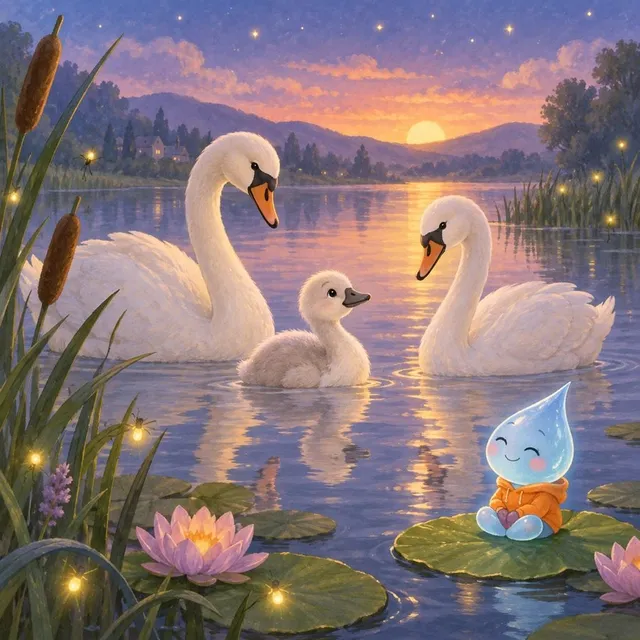
He flew over the fields until he saw a sparkling lake. And there, gliding on the water, were the beautiful white birds he had seen in autumn.
He landed gently on the lake and bowed his head. And then he saw his reflection in the water.
He was not a gray duckling anymore. He was white, with a long, graceful neck and wide, shining wings.
He was a swan.
The other swans swam over to him. "Welcome," they said. "We've been waiting for you." They gently touched their beaks to his feathers, and he knew he was home.
Children on the shore pointed and smiled. "Look! A new swan! He's the most beautiful of all!"
But the young swan wasn't proud. He was just happy. Happy to be himself, and happy to belong.
That evening, as the sun set over the lake, he tucked his head under his soft white wing, and floated, gently, gently, on the calm water, until he was fast asleep.
You are exactly who you are meant to be, too. Tuck yourself in, like a swan on a quiet lake… and drift off to sleep.
Good night.