Droply
Once upon a time, in a little town with crooked roofs, there lived a kind shoemaker and his wife. The shoemaker worked hard every day, but times were difficult, and one evening he had only enough leather left for one single pair of shoes.
He cut the leather carefully, laid the pieces on his workbench, and said, "I'll sew them in the morning." Then he blew out the candle and went to bed.
In the morning, he came downstairs… and he stopped. There, on the workbench, stood a pair of shoes. Finished! Every stitch was tiny and neat. Every edge was smooth. They were the most beautiful shoes he had ever seen.
"Wife!" he called. "Come and look!"
That very day, a gentleman walked into the shop, saw the shoes, and loved them so much that he paid double the price. With the money, the shoemaker bought leather for two pairs of shoes.
That night, he cut the leather, laid it on the workbench, and went to bed.
And in the morning… two pairs of shoes stood waiting. Finished! Tiny stitches. Smooth edges. So beautiful.
The next night, he cut leather for four pairs. In the morning, four pairs stood waiting. And so it went, night after night, until the little shop was busy and bright, and the shoemaker and his wife never worried again.
One snowy evening, just before the winter holidays, the wife said, "I wonder who is helping us. Let's stay up and see."
So they lit a candle, hid behind the coats in the corner, and waited very, very quietly.
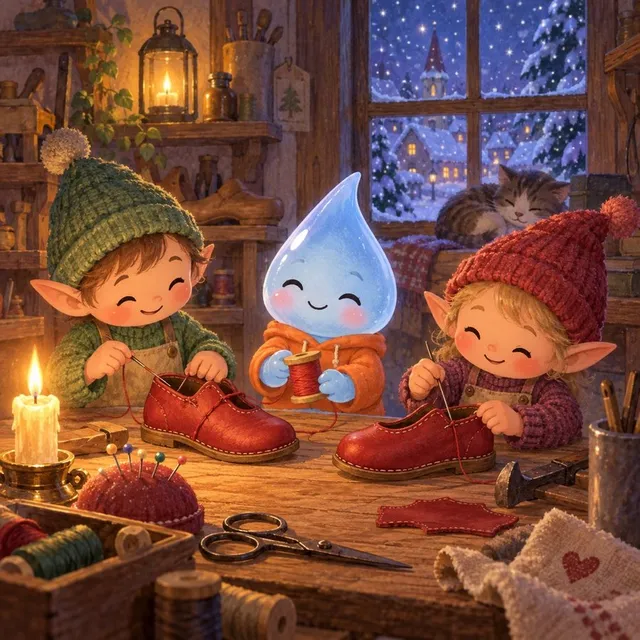
At midnight… tip-tap, tip-tap… two tiny elves came skipping in. They climbed onto the workbench, picked up the leather, and began to sew. Stitch, stitch, tap, tap, their little fingers flew. But the shoemaker's wife noticed something. The elves had no coats, no hats, and no shoes of their own. They were shivering in the cold.
When the work was done, the elves skipped away into the night.
"They have helped us so much," whispered the wife. "Let's make them something warm."
So she sewed two tiny shirts, two tiny coats, and two tiny woolly hats. She knitted two pairs of tiny socks. And the shoemaker made two pairs of the smallest shoes in the world.
That night, instead of leather, they laid the little clothes on the workbench, and hid again.
At midnight… tip-tap, tip-tap… in came the elves. They saw the gifts, and their faces lit up with joy. They put on the shirts and the coats, the hats and the socks and the shoes. They twirled and they laughed and they danced all around the workshop. Then they skipped out the door, warm and happy, and never needed to come back.
The shoemaker and his wife lived happily for the rest of their days. And every night, before they went to sleep, they left a little candle glowing in the window… just in case two tiny friends passed by.
Now the workshop is quiet. The candle is glowing softly. Tip-tap… tip-tap… it's time for little feet to rest.
Good night.